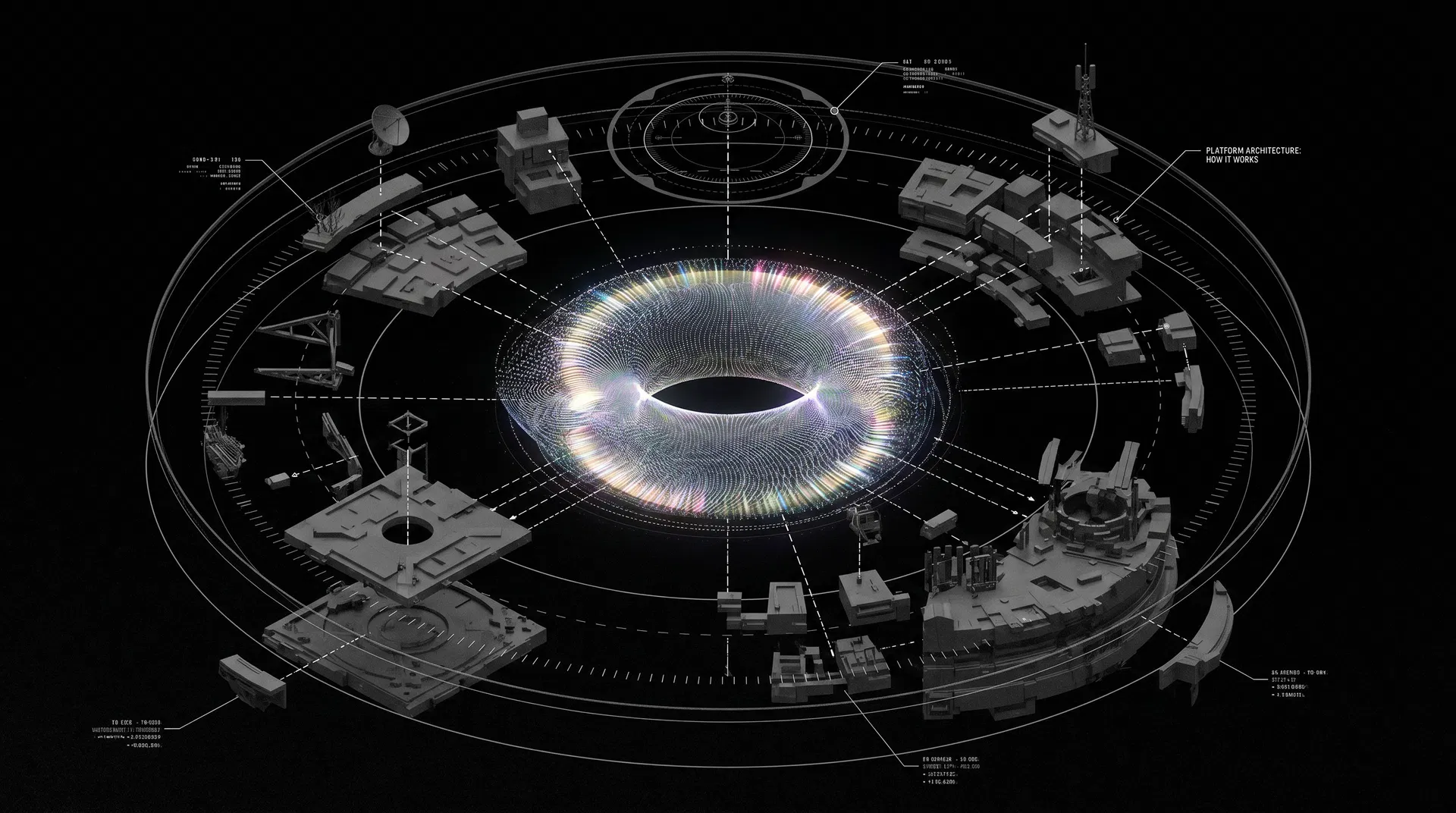
VescelDB: The Database for Digital Possession
Digital possession needs more than encrypted storage. It needs identity, custody, permission, evidence, and a lifecycle for the object itself.
Abstract
The digital economy has never lacked places to store things. It has lacked a way to know which thing is the authoritative object, who may act on it, where it is held, and what evidence proves that an action occurred. VescelDB is Onli's answer to that gap. It is not a file system, a cloud drive, or a ledger. It is the property database for possessable digital objects.
The central claim is simple: a digital object can be reproducible as data while remaining singular as property. Copies of encrypted bytes may exist for storage, staging, or recovery. Those copies do not create new ownership. They do not create new authority. They do not create a second valid object. Possession is the recognized relationship among the object, the participant, the holding context, and the rules that permit action.
VescelDB exists to preserve that relationship. A PackageMaker seals digital material as a Package. A Crypt carries that Package through its property lifecycle. A Vescel holds Crypts in an Onli context. OnliYou authenticates participants. usePolicy defines governed use. A Locker constrains conditional exchange. Receipts, commitments, and operation records establish what happened without requiring every party to see the underlying content.
The result is a database organized around possession rather than access. It lets ownership remain separate from custody, validation remain separate from disclosure, and title remain separate from storage. That is the foundation needed for digital objects that can be held, governed, transferred, recovered, and trusted.
The Problem: Storage Is Not Possession
Modern software treats digital material as something to copy, sync, back up, and retrieve. That is useful for information. It is fatal for property.
A file can be duplicated perfectly. A database row can be replicated across regions. An encrypted archive can be backed up in multiple places. None of this answers the property question: which instance is the recognized object, who may act on it, and what evidence proves the result of an action?
This is the distinction VescelDB is built around. A copy of encrypted material may preserve content. It does not establish ownership. It does not authorize retrieval. It does not prove custody. It does not revive an object after a terminal action. In a possession system, the bytes matter, but the relationship around the bytes matters just as much.
The useful analogy is not a folder. It is a chain of custody. The point is not merely that material exists. The point is that a particular object can be identified through manufacture, holding, transfer, validation, recovery, and completion. VescelDB gives that object a recognized lifecycle.
The argument in one line. VescelDB turns digital material into a governed object by preserving the relationship between identity, authority, custody, permitted action, and evidence.
The Object Model
VescelDB separates the thing being protected from the system that holds it. That separation is the first move away from ordinary cloud storage.
A PackageMaker prepares and seals the material. It may be a document maker, a title maker, a species-specific maker, or any domain-specific process that knows what the material means. The output is a Package: the sealed representation of the protected material.
A Crypt contains the Package and carries the identity and state needed for the object's property lifecycle. A Crypt is not just a wrapper. It is the object whose ownership, custody, permissions, receipts, and terminal state can be governed.
A Vescel is the holding environment. It holds Crypts in a context connected to an Onli identity, an appliance identity, and storage. VescelDB manages this hierarchy and the evidence that makes its state meaningful.
| Layer | Role | What it does not do |
|---|---|---|
| PackageMaker | Creates and seals protected material | It does not become the storage container |
| Package | Holds the sealed representation | It does not by itself decide who may act |
| Crypt | Carries the Package through its property lifecycle | It is not merely metadata |
| Vescel | Provides the holding context | It does not automatically own every Crypt it holds |
| VescelDB | Coordinates lifecycle, evidence, and permitted actions | It does not define every domain meaning |
This model lets VescelDB be general without becoming vague. The PackageMaker supplies specialized meaning. VescelDB supplies possession structure. An art object, a confidential document, a title instrument, and a governed dataset can all use the same property layer while relying on different makers for their domain-specific interpretation.
Identity, Content, and Context
Every possessable object has three dimensions.
Identity tells the system which object is under discussion. Without stable identity, a valid approval could be applied to substituted material. VescelDB therefore needs evidence that binds decisions to the exact Crypt and Package involved.
Content is the protected material. VescelDB preserves the relationship to that material, but it does not need to understand every possible meaning of it. A PackageMaker may know that a Package is a deed, a model, a license, or a private document. VescelDB knows the object, its binding, and the lifecycle evidence around it.
Context is the current relationship around the object. Ownership may change. Custody may move. A usePolicy may constrain what can happen next. A Label may be revised without changing the sealed Package. These contextual changes matter because future authority depends on the object's recognized history.
The important point is that continuity does not mean nothing changes. It means the same object persists through controlled changes of relationship. The origin can remain the origin while the owner changes. The content can remain sealed while a validation result is produced. The holding location can move while the property identity remains intact.
That is the architecture of possession: stable identity, protected content, and governed context.
Authentication Is Not Ownership
OnliYou authenticates the participant entering a VescelDB interaction. It answers the first question: who is here?
It does not answer every other question.
An authenticated participant may own the Crypt. They may own the Vescel that holds the Crypt. They may be a custodian. They may be a recipient in a conditional exchange. They may have no authority over the object at all. VescelDB must evaluate the participant's relationship to the exact object before it permits an action.
This distinction matters because access systems often collapse identity into authority. If a user can log in, the platform assumes the user may act. VescelDB cannot make that assumption. A sign-in is not consent to move custody. A custodian is not the owner. A visible Label is not permission to retrieve the Package. A pending approval is not approval.
Some actions require their own decision. Moving a Crypt between Local and Cloud custody, for example, is not the same act as logging into the system. The approval must identify the object, the direction, the operation, and the custody context. If the participant declines, the answer is no. If the response is interrupted, the outcome may be unknown and must be reconciled rather than guessed.
This is less convenient than pretending login means everything. It is also the reason the model can support property. Ownership is not a session. It is an authority relationship.
Ownership, Custody, and Title
VescelDB keeps three relationships separate because collapsing them creates confusion.
Ownership identifies the party with powers reserved to the Crypt owner.
Custody identifies the recognized holding relationship.
Title represents an authoritative relationship to the Package whose meaning is defined by the maker and application domain.
These relationships can move together, but they are not the same. An owner can hold a Crypt directly. An owner can also place a Crypt with a custodian. The custodian may have limited powers, such as reading a Label and returning custody. That does not imply authority to open the Package, transfer ownership, invoke Title, or perform a terminal action.
Title is also distinct. A PackageMaker may define a specialized title process for a Package. VescelDB can supply the exact object and permitted custody evidence needed by that process, then record the result. VescelDB does not invent the title relationship on its own. The application domain gives title its meaning.
| Relationship | What changes | What remains distinct |
|---|---|---|
| Custody | The recognized holder | The holder need not become the owner |
| Ownership | The party with owner powers | Manufacture and provenance remain historical facts |
| Title | The maker-defined represented interest | Title is not created by login or storage alone |
This is how a digital object can support real commercial relationships. A marketplace can arrange exchange. A custodian can hold. A PackageMaker can interpret title. OnliYou can authenticate. VescelDB can preserve the object lifecycle and the evidence of each result without assigning every role the same power.
Governed Use
Possession becomes more powerful when use can be governed without surrendering the object to a platform administrator. That is the role of usePolicy.
A usePolicy defines the terms of a particular use relationship. It identifies the participant, the object, the action, the execution context, the duration, and the conditions under which the action is permitted. The policy is not useful if it merely says "access." Access to what? For whom? Under which evidence? For how long? With what result?
A condition must have an authority. If ownership changes after payment, the policy must identify the settlement evidence that proves payment occurred. If custody returns after a deadline, the policy must define the deadline and the result. If a fact is unknown because the evidence source is unavailable, that is not the same as the fact being false.
The Locker is the controlled context for this kind of committed process. A Crypt can enter a Locker under defined terms, have its eligible actions constrained, and leave according to the established outcome. A Locker is not ordinary custody. It exists to resolve a governed relationship.
This makes conditional exchange possible without making the platform omnipotent. The platform does not simply decide what happened. It applies the agreed terms to the designated evidence and records the result.
Evidence Without Routine Disclosure
VescelDB's evidence model is as important as its object model. A participant often needs to prove a bounded claim without seeing the underlying material.
A recipient may need to know that a confidential document was sealed by a trusted maker. A custodian may need to know which Crypt it holds without opening the Package. A marketplace may need settlement evidence without receiving the protected content. A verifier may need to validate a claim for a limited time.
The evidence must therefore keep its scope.
| Evidence | What it can establish | What it does not establish |
|---|---|---|
| Package Label | The maker's readable declaration | The full truth of every statement in the content |
| Maker proof | A trusted maker sealed the exact Package | Ownership, settlement, or custody by itself |
| Storage commitment | VescelDB holds material bound to the Crypt | Title or domain meaning by itself |
| Custody evidence | A recognized holding relationship exists | Unrestricted owner authority |
| Operation receipt | A specific action produced a result | Completion of unrelated actions |
This lets privacy and accountability coexist. The system does not need to publish everything to everyone. It needs durable evidence available to the parties entitled to establish the result.
That is a different design philosophy from public ledgers. Public ledgers make visibility do the work. VescelDB makes scoped evidence do the work.
Lifecycle and Recovery
The VescelDB object lifecycle begins with manufacture and ends only when the relevant terminal action has been completed and recorded. Between those points, the object can be inspected, validated, governed, moved, transferred, opened, or recovered according to its state and authority.
A typical lifecycle has this shape:
| Stage | Effect |
|---|---|
| Fill and Seal | A PackageMaker prepares protected material |
| Manufacture | The Package is admitted as a Crypt with identity and storage evidence |
| Inspect and Validate | Permitted metadata and evidence establish bounded claims |
| Govern and Title | Defined use or maker-specific title relationships are established |
| Custody | The recognized holding relationship changes |
| Transfer | Crypt ownership changes |
| OpenPackage | An eligible Package is retrieved and the Crypt is consumed |
| Terminal record | The final result is retained for accountability |
Recovery does not mean rolling back property history. A recovery archive may preserve material and evidence, but it cannot independently create a new active possession. If ownership changed after the archive was made, recovery must respect that later event. If a terminal action consumed the Crypt, an older copy of encrypted bytes cannot revive it.
This is one of the sharpest differences between storage and possession. Storage asks whether the bytes can be restored. Possession asks whether the restored state is still authoritative.
Local and Cloud Custody
VescelDB supports different operating contexts without changing the property model. A Crypt may be held locally or in Cloud custody. Movement between those contexts must preserve one recognized lifecycle rather than create two active holdings.
Preparation of a destination is not activation. A destination may receive the exact material and required evidence so that movement can complete. Until the source holding is retired and the destination is activated, preparation alone does not create an additional possession.
This distinction is what prevents backup mechanics from turning into ownership confusion. Local and Cloud can coordinate custody while preserving the rule that there is one recognized object lifecycle. The Package, origin, maker evidence, and relevant commitments continue. The valid holding location changes.
A disconnected Local manager creates a related problem. If the Cloud side cannot observe a Local inventory, it cannot assume the Local holding is empty. Lack of observation is not evidence of absence. Inventory is a scoped observation, not a permanent statement of all facts.
VescelDB therefore treats movement, observation, and recovery as property events, not merely synchronization events.
What VescelDB Makes Possible
The practical value of VescelDB appears wherever the identity and disposition of a particular digital object matter.
In controlled document delivery, a maker seals a confidential document, the owner and recipient authenticate, and the agreement specifies whether delivery changes custody, ownership, or both. The result is not just that a file was sent. It is a determinate account of which object was sealed, who authorized its disposition, and whether retrieval completed.
In custody on behalf of an owner, a custodian holds a Crypt without gaining owner powers. The custodian can perform the limited actions assigned to custody and return the object when authorized. Holding is useful precisely because it does not swallow ownership.
In conditional ownership transfer, a seller and recipient agree that ownership changes after a defined settlement event. A Locker constrains the Crypt while the marketplace arranges the commercial experience, the settlement authority establishes the payment fact, and VescelDB performs the eligible transition.
In bounded validation, a participant can request a claim about an object without requesting its contents. The verifier, maker, or fact provider supplies the interpretation, and VescelDB contributes the object and custody evidence needed to make the result meaningful.
These examples are not separate products. They are consequences of the same model: exact object, authenticated participant, permitted action, designated evidence, durable outcome.
Economic Implications
The economic thesis is not that scarcity magically creates demand. It does not. A useless object is still useless when it is scarce.
The thesis is narrower and stronger: when the identity and disposition of a digital object matter, reliable possession can create utility that ordinary storage cannot. A participant may value provenance, recognized holding, governed use, accountable custody, conditional transfer, title, or proof that an operation occurred.
This creates room for specialization. PackageMakers can create and interpret domain-specific objects. Custodians can hold without owning. Marketplaces can arrange exchange. Fact providers can establish settlement or delivery evidence. OnliYou can authenticate participants. VescelDB can preserve the shared property lifecycle.
The architecture also changes the fee logic. A possession database does not require a public blockchain consensus fee for every action. Commercial implementations may have their own pricing, infrastructure costs, and provider dependencies, but the property model itself is not built around paying a global network to agree on a ledger. It is built around identifiable objects, scoped authority, and evidence.
That is the difference between buying database entries and managing digital property.
Conclusion: The Possession Database
VescelDB can be understood as the database for digital possession. It preserves the continuity of an identified object while allowing authorized changes to ownership, custody, title, policy, location, validation, and completion.
Its contribution is not a single trick. It is the coordination of distinctions that ordinary digital systems collapse:
- data and property
- authentication and authority
- custody and ownership
- title and storage
- validation and disclosure
- backup and recovery
- request and outcome
- evidence and interpretation
Those distinctions are what let a digital object behave less like a copied file and more like a thing that can be held.
The larger Onli thesis is that digital property requires actual possession. VescelDB is the operating layer that makes that thesis usable. It gives the object a place to live, a history to preserve, a set of powers to respect, and evidence for the actions that matter.
The digital economy already has storage. What it needs now is possession. VescelDB is the database for that.
Source Basis
This rewrite is based on the September 23, 2026 source paper "VescelDB Whitepaper: A conceptual architecture for digital possession and governed use." It preserves the paper's core conceptual claims while adapting its structure and language to the withonli whitepaper style.
The source paper synthesizes VescelDB V5 materials covering the Canon, Architecture, Package Binding, Operations, Unmake, Nomenclature, Label Replacement, OnliYou member authentication, product boundaries, tools and assistant interfaces, usePolicy Locker research, Species CloudLocker engineering, and OBTC VescelDB engineering.