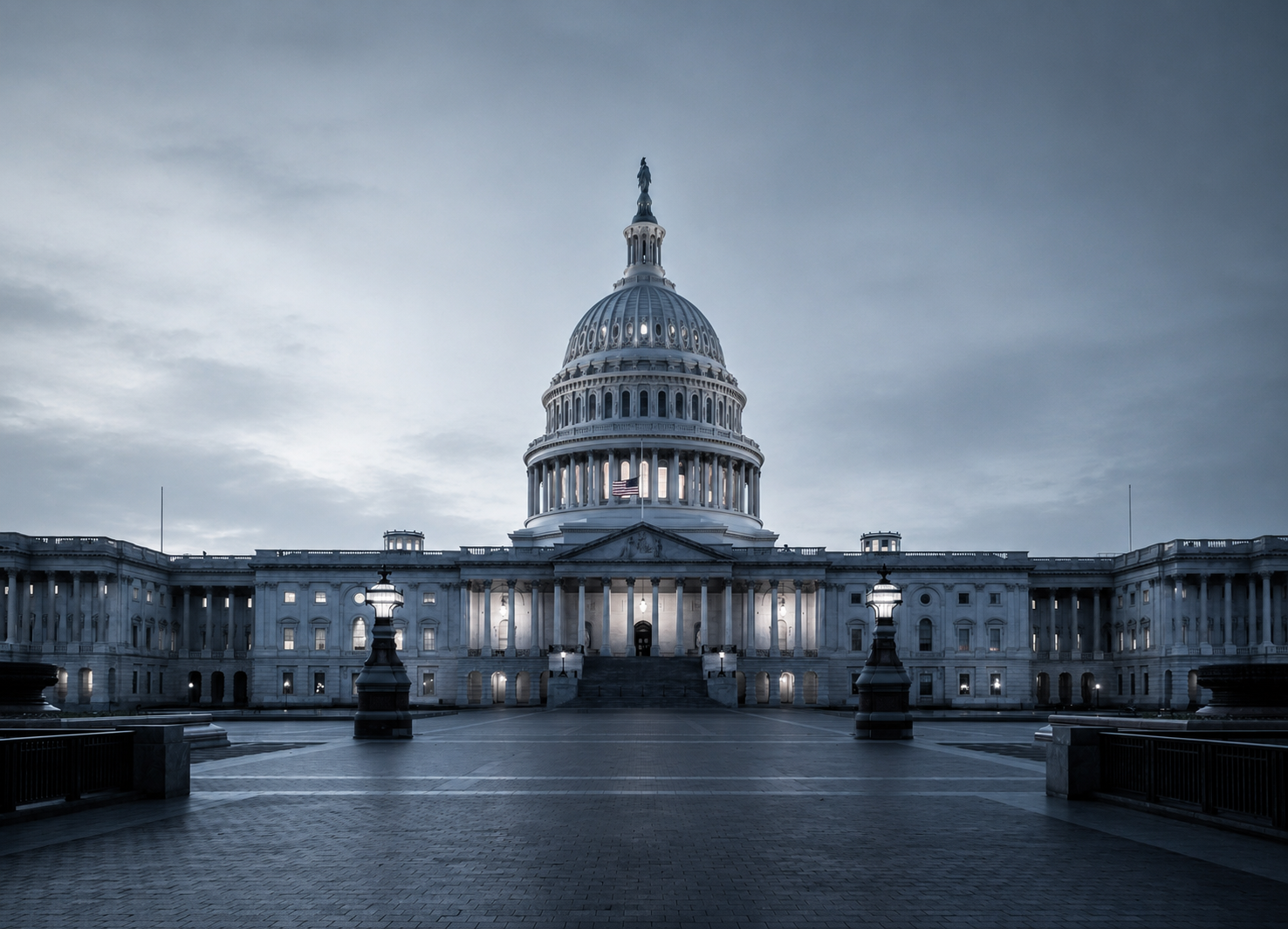
The Line Congress Just Drew: What the Federal CBDC Ban Means for Private, Dollar-Denominated Currency
July 2026
On June 22, 2026, severe thunderstorms grounded flights at Reagan National Airport, leaving several senators stranded and absent from the chamber floor. It was an inauspicious backdrop for a historic vote. Despite the weather, the United States Senate passed the 21st Century ROAD to Housing Act by a decisive margin of 85-5. [1] The following day, the House of Representatives approved the reconciled version 358-32. [1] The legislation was publicly celebrated as a sweeping housing affordability package — a rare bipartisan achievement in a fractious Congress — and the headlines duly focused on zoning reform, manufactured housing standards, and restrictions on institutional investors purchasing single-family homes.
Almost no one noticed Section 1001.
Tucked within this housing bill was a provision of profound consequence for the future of money in the United States. Section 1001 established the first explicit statutory prohibition in American history on a Federal Reserve-issued central bank digital currency, effective through December 31, 2030. [1] The bill text is unambiguous: "the Board of Governors of the Federal Reserve System or a Federal reserve bank may not issue or create a central bank digital currency or any digital asset that is substantially similar to a central bank digital currency directly or indirectly through a financial institution or other intermediary." Four years. Statutory. Federal law.
The puzzle is immediate. The Federal Reserve had no active project to build a central bank digital currency. The Fed's own public-facing page on the topic, last updated in February 2026, described its work as exploratory research rather than active development. [2] In January 2025, President Donald Trump signed an executive order declaring that a digital dollar would "threaten the stability of the financial system, individual privacy, and the sovereignty of the United States," prohibiting any federal agency from taking steps toward establishing or promoting a central bank digital currency. [3] The newly nominated Federal Reserve Chair, Kevin Warsh, testified during his confirmation hearing that he fully opposed a U.S. central bank digital currency, calling it a "bad policy choice." [4] Congress expended enormous political capital — years of legislative effort, multiple failed standalone bills, and ultimately a strategic attachment to a must-pass housing vehicle — to ban a technology that was not being built, by an agency that did not want to build it, under an administration that had already forbidden it by executive order.
Why would Congress go to such lengths to ban something that wasn't happening?
The answer requires understanding a distinction that most coverage of this legislation missed entirely. Section 1001 does not merely prohibit a central bank digital currency. It draws a definitive line in federal statute between two fundamentally different architectures of money. The prohibition targets centrally controlled, surveillance-capable digital instruments. But the legislation explicitly exempts "dollar-denominated currency that is open, permissionless, and private." [1] In a single provision, Congress established two distinct legal categories of digital money. One is banned. The other is protected. This is not a footnote. This is the entire point.
To appreciate why this distinction matters so deeply, it is necessary to understand what a central bank digital currency actually is — and what it would enable. A central bank digital currency, or CBDC, is a form of digital money that is a direct liability of the central bank. Unlike a commercial bank deposit, which is a claim on a private institution, a CBDC would be a claim directly on the government. Unlike physical cash, which is anonymous and untraceable, a CBDC would be programmable. Every transaction would be recorded on a ledger controlled by the issuing authority. The government would have the technical capability to observe, restrict, freeze, or redirect any payment in the system. It could set expiration dates on money. It could restrict spending to approved categories. It could exclude individuals from the financial system entirely without requiring a court order or a warrant.
This is not speculation. These capabilities are features, not bugs, of central bank digital currency design. The European Central Bank, which has been developing a digital euro with a pilot program expected to launch in 2027 and a full rollout targeted for 2029, has acknowledged the programmability question directly. [4] China's e-CNY, the most advanced central bank digital currency in a major economy, has been expanded to include interest-bearing capabilities as of January 2026, with the People's Bank of China adding a dozen new banks to its operator network in early 2026. [5] The e-CNY is explicitly designed to give the Chinese government real-time visibility into the transaction behavior of its citizens. The architecture is the policy.
The United States has been building a less visible but equally comprehensive architecture of financial surveillance for more than fifty years. The Bank Secrecy Act of 1970 transformed banks into instruments of the state, requiring them to maintain records on customers and report transactions above ten thousand dollars to the government. [6] The reporting threshold was set in 1970 and has never been adjusted for inflation; in real terms, it would exceed seventy-five thousand dollars today. [6] In 2023 alone, financial institutions filed over 26 million Bank Secrecy Act reports on Americans, at a compliance cost to the financial sector of approximately 45.9 billion dollars. [6] The Patriot Act of 2001 dramatically expanded these obligations, introducing new customer identification requirements, expanding mandatory reporting, and prohibiting banks from notifying customers when those reports were filed. [6] The Biden administration proposed in 2021 to extend mandatory reporting to any bank account with as little as six hundred dollars in annual activity — a proposal that was ultimately abandoned after public outcry, but whose existence revealed the direction of the underlying impulse. [6]
The House Judiciary Committee's December 2024 interim report on financial surveillance documented the system's current state with startling specificity. In 2023, approximately 25,000 authorized users across federal, state, and local government had warrantless access to Bank Secrecy Act filings through the FinCEN Query program. Government officials ran 3,362,735 searches of those filings in a single year. Approximately 27,000 federal officials could download the data directly onto agency systems. In total, 472 federal, state, and local law enforcement, regulatory, and national security agencies had access to Bank Secrecy Act reports. [7] The report also documented that following the events of January 6, 2021, Bank of America voluntarily provided the FBI with a list of every customer who had used a credit or debit card in the Washington, D.C. region around that time — without a warrant, without legal process, and without notifying any of the customers involved. [7]
A central bank digital currency would not have created this surveillance infrastructure. It would have perfected it. The existing system still requires the government to work through private financial institutions, to file requests, to navigate legal process, to deal with the friction of third-party intermediaries. A direct liability of the central bank would eliminate that friction entirely. It would close the air gap between the citizen's financial life and the government's complete knowledge of it.
This is the context in which Section 1001 must be understood. The 85-5 Senate vote was not primarily about housing. It was about architecture. It was a legislative declaration that the United States would not build the infrastructure for total financial surveillance — at least not in the form of a government-issued digital dollar. The bipartisan coalition that produced this vote was assembled around a housing bill, but the underlying consensus was about something more fundamental: the relationship between citizens and the state in a world where money is programmable.
Here is where the conventional interpretation of this legislation falls short. Most observers read Section 1001 as a victory for Bitcoin advocates, for cryptocurrency enthusiasts, for anyone who fears government overreach into financial life. And it is those things. But it is also something more precise and more consequential. By explicitly protecting "dollar-denominated currency that is open, permissionless, and private," Congress has ratified a legal principle that extends far beyond Bitcoin. It has acknowledged that private, purpose-built digital instruments operating within bounded economies are a distinct legal category from public money. The surveillance rail is banned. The freedom rail is protected. The line is now in federal statute.
Understanding why this distinction matters requires a brief excursion into the legal architecture of money itself. The Financial Crimes Enforcement Network, the Treasury Department bureau responsible for administering the Bank Secrecy Act, defines currency as legal tender that circulates broadly as a medium of exchange. [8] Private instruments confined to specific communities, purposes, or ecosystems do not meet this standard. They are not currency in the regulatory sense. They are something else — and that something else has historically received meaningful legal protections.
Consider the casino chip. A casino chip functions as private scrip within a bounded economy. It facilitates exchange, represents value, and settles transactions instantly. Yet it is not legal tender, it cannot be used to pay taxes, and it has no purchasing power outside the casino floor. The government regulates the casino operator's conduct — anti-money laundering obligations, licensing requirements, reporting thresholds — but it does not regulate the chip itself as currency. The chip is a private instrument in a closed-loop system. The distinction is not semantic. It is the foundation of an entire regulatory framework that treats closed-loop payment systems differently from open, general-purpose money.
Money transmission rules, at both the federal and state level, target the acceptance and transfer of value that substitutes for currency. Closed-loop systems — limited to specific merchants, locations, or purposes — receive meaningful exclusions under these frameworks. The principle is straightforward: a private, purpose-built instrument in a bounded economy is a different legal animal from open, general-purpose money. Section 1001 did not create this principle. It ratified it. It elevated it to black-letter federal statute.
This is the architecture Onli was designed around. The Onli Corporation draws a precise, functional line between two types of specialized digital assets. A micro-currency represents a measure or amount of value. If you own one, you own a quantity — similar to owning dollars in an account or units of a denomination. It is fungible within its purpose-built context, whether that context is a supply chain, a marketplace, a membership network, or a vendor ecosystem. A micro-commodity, by contrast, represents a discrete, ownable thing or claim. If you own one, you own a specific asset — a singular title, right, or item — not a quantity. Before creating any asset on the Onli platform, issuers must answer two foundational questions: Is this a currency or a commodity? And within that category, what form of ownership relationship does it represent? These distinctions determine the asset's regulatory posture and its operational behavior from the moment of creation.
The implications are significant. Because Onli instruments are structured to respect the boundary between private scrip and public money — they are not legal tender, they are not marketed as competing with the dollar, and they operate within permissioned, private economies — they align precisely with the statutory protections codified in Section 1001. The legislation did not change Onli's architecture. It confirmed that Onli's architecture was right.
Onli is not a blockchain. This distinction is worth dwelling on, because the word blockchain has become so associated with digital assets that many observers assume it is synonymous with them. It is not. Blockchain is a specific technology — a distributed ledger in which transactions are recorded publicly across a network of participants, with each new block cryptographically linked to the previous one. Blockchain is public by default. It is transparent by design. Its settlement is probabilistic, subject to confirmation delays, forks, and reorganization risk. It carries ongoing transaction costs in the form of gas fees or mining rewards. And its compliance architecture is retrofitted onto a system that was not designed with regulatory requirements in mind.
Onli is a possession-based system. Assets exist as unique, cryptographically bound objects held directly in personal Vaults — much like cash in a pocket rather than an entry in a shared ledger. This is actual possession. When you hold an Onli asset, you hold it. You do not hold a claim on a ledger entry. You hold the thing itself. Settlement is instant, atomic, and final. There are no confirmation delays, no forks, no settlement risk. Privacy is the default condition, not an add-on, because transactions occur on a private network rather than a public ledger. Transaction fees are zero, permanently, because there is no mining, no gas, and no per-transfer cost structure. And compliance is engineered into the asset itself. Identity verification, credentialing, and asset-level geofencing enforce jurisdictional and regulatory controls before a transfer can occur, rather than attempting to impose them after the fact.
The passage of the GENIUS Act in July 2025 established the first federal regulatory framework for payment stablecoins, requiring 1:1 reserve backing with liquid assets, monthly public disclosures, and strict obligations on instruments designed and marketed for general payment or settlement. [9] The GENIUS Act explicitly subjects stablecoin issuers to the Bank Secrecy Act, requiring anti-money laundering programs, sanctions compliance, and the technical capability to seize, freeze, or burn payment stablecoins when legally required. [9] A properly structured Onli micro-currency — closed-loop, purpose-built, and not promoted as a public payment tool — falls outside this regime. Broader obligations such as OFAC sanctions screening and proportional Bank Secrecy Act practices still apply, but the Onli platform-level architecture addresses these requirements natively, ensuring compliance without sacrificing the privacy of the transaction graph.
The stablecoin market provides useful context for the scale of what is now at stake. Dollar-denominated stablecoins account for over 90% of the total stablecoin market, which crossed 300 billion dollars in market capitalization in late 2025 and processed approximately 33 trillion dollars in transfer volume during the year. [10] The United States has chosen, deliberately and now statutorily, to pursue dollar dominance through private, permissionless instruments rather than through a government-issued digital dollar. The GENIUS Act creates the framework for open stablecoins. Section 1001 of the 21st Century ROAD to Housing Act protects the broader ecosystem of private, dollar-denominated instruments. Together, these two pieces of legislation define the American approach to digital money: private architecture, public accountability, permissionless rails.
Section 1001 provides four years of explicit federal cover. The prohibition sunsets on December 31, 2030. [1] The political coalition that produced an 85-5 Senate vote was assembled around a housing bill, and that coalition may not reassemble when the housing urgency is gone. Representatives Anna Paulina Luna, Tom Emmer, and Senator Ted Cruz have all publicly called for a permanent ban, and the pressure for a no-sunset amendment or a standalone permanent prohibition will need to be sustained before the clock runs out. The 2030 expiration is a genuine vulnerability in the legislative architecture.
But the deeper legal architecture will outlast the sunset. The definitions of currency, the exclusions for closed-loop systems, the fundamental distinction between private instruments and public money — these principles predate this bill by decades and are embedded in FinCEN guidance, federal case law, and state money transmission frameworks. Section 1001 did not create these principles. It elevated them. It made them explicit. It gave them the weight of a congressional declaration in a bill that passed with near-unanimity.
What changes next is the question worth sitting with. The global economy is moving toward digital settlement with or without American participation. China's e-CNY continues to expand, adding interest-bearing capabilities and new operator banks throughout 2026. [5] The European Central Bank is on track for a digital euro launch in 2029. [4] The international payment gap — the friction-laden, expensive, slow process of moving dollar-denominated value across borders — will be filled by something. The question is whether it will be filled by government-issued surveillance instruments or by private, possession-based digital property.
The organizations that understand the difference between public currency and private digital property will build the infrastructure for the next era of capital formation. They will recognize that the line Congress drew is not just a regulatory boundary. It is a map. It shows exactly where the architecture of private digital markets can operate, what it must avoid, and why the design principles of actual possession, embedded governance, and hardware-enforced trust are not merely technical preferences. They are the natural architectural response to a world in which the government has drawn a clear distinction between the money it controls and the property you own.
The assumption becoming obsolete is the one that treats all digital money as equivalent — that assumes a stablecoin, a CBDC, a casino chip, and an Onli micro-currency are all variations of the same thing. They are not. They are architecturally, legally, and philosophically distinct. Section 1001 made that distinction federal law. The next four years will determine who builds on it.
References
[1] TFTC Newsdesk. "Senate Passes 85-5 CBDC Ban Inside Housing Bill, Now Back to the House." TFTC.io, June 23, 2026. https://www.tftc.io/cbdc-ban-senate-85-5-housing-bill-four-year-sunset
[2] Federal Reserve Board. "Central Bank Digital Currency." Board of Governors of the Federal Reserve System, updated February 26, 2026. https://www.federalreserve.gov/central-bank-digital-currency.htm
[3] The White House. "Strengthening American Leadership in Digital Financial Technology." Presidential Executive Order, January 23, 2025. https://www.whitehouse.gov/presidential-actions/2025/01/strengthening-american-leadership-in-digital-financial-technology/
[4] Hamilton, Jesse. "U.S. Senate Passes Housing Bill That Carries Four-Year Ban on a Fed CBDC." CoinDesk, June 22, 2026. https://www.coindesk.com/policy/2026/06/22/u-s-senate-passes-housing-bill-that-carries-four-year-ban-on-a-fed-cbdc
[5] Reuters. "China to Allow More Banks to Handle Digital Yuan, Sources Say." Reuters, March 26, 2026. https://www.reuters.com/world/asia-pacific/chinas-bank-ningbo-readies-digital-yuan-business-beijing-expands-e-cny-2026-03-20/
[6] Anthony, Nicholas. "CBDC Spells Doom for Financial Privacy." Cato Institute, Free Society, Fall 2024. https://www.cato.org/free-society/fall-2024/cbdc-spells-doom-financial-privacy
[7] Committee on the Judiciary and Select Subcommittee on the Weaponization of the Federal Government, U.S. House of Representatives. "Financial Surveillance in the United States: How the Federal Government Weaponized the Bank Secrecy Act to Spy on Americans." Interim Staff Report, December 6, 2024. https://judiciary.house.gov/sites/evo-subsites/republicans-judiciary.house.gov/files/2024-12/2024-12-05-Financial-Surveillance-in-the-United-States.pdf
[8] Financial Crimes Enforcement Network. "Application of FinCEN's Regulations to Persons Administering, Exchanging, or Using Virtual Currencies." Guidance FIN-2013-G001, March 18, 2013. https://www.fincen.gov/resources/statutes-regulations/guidance/application-fincens-regulations-persons-administering
[9] The White House. "Fact Sheet: President Donald J. Trump Signs GENIUS Act into Law." July 18, 2025. https://www.whitehouse.gov/fact-sheets/2025/07/fact-sheet-president-donald-j-trump-signs-genius-act-into-law/
[10] European Central Bank. "Stablecoins and the Future of Money: Separating Functions from Structures." Speech by ECB Executive Board Member, May 8, 2026. https://www.ecb.europa.eu/press/key/date/2026/html/ecb.sp260508~dd909fbed1.en.html
About The Onli Corporation
The Onli Corporation develops infrastructure for creating, financing, delivering, and governing entirely new classes of digital assets. Through actual possession, private digital markets, and programmable digital property, Onli enables organizations to build secure, scalable digital economies beyond the limitations of traditional blockchain architectures.
To learn more, contact hello@theonlicorporation.com.
Download OnliYou on the Apple App Store.
Develop on the Onli platform at https://onli.cloud.