The Rack Is Not Inevitable
What a 2019 Mac Pro experiment can tell us about where intelligence is allowed to live
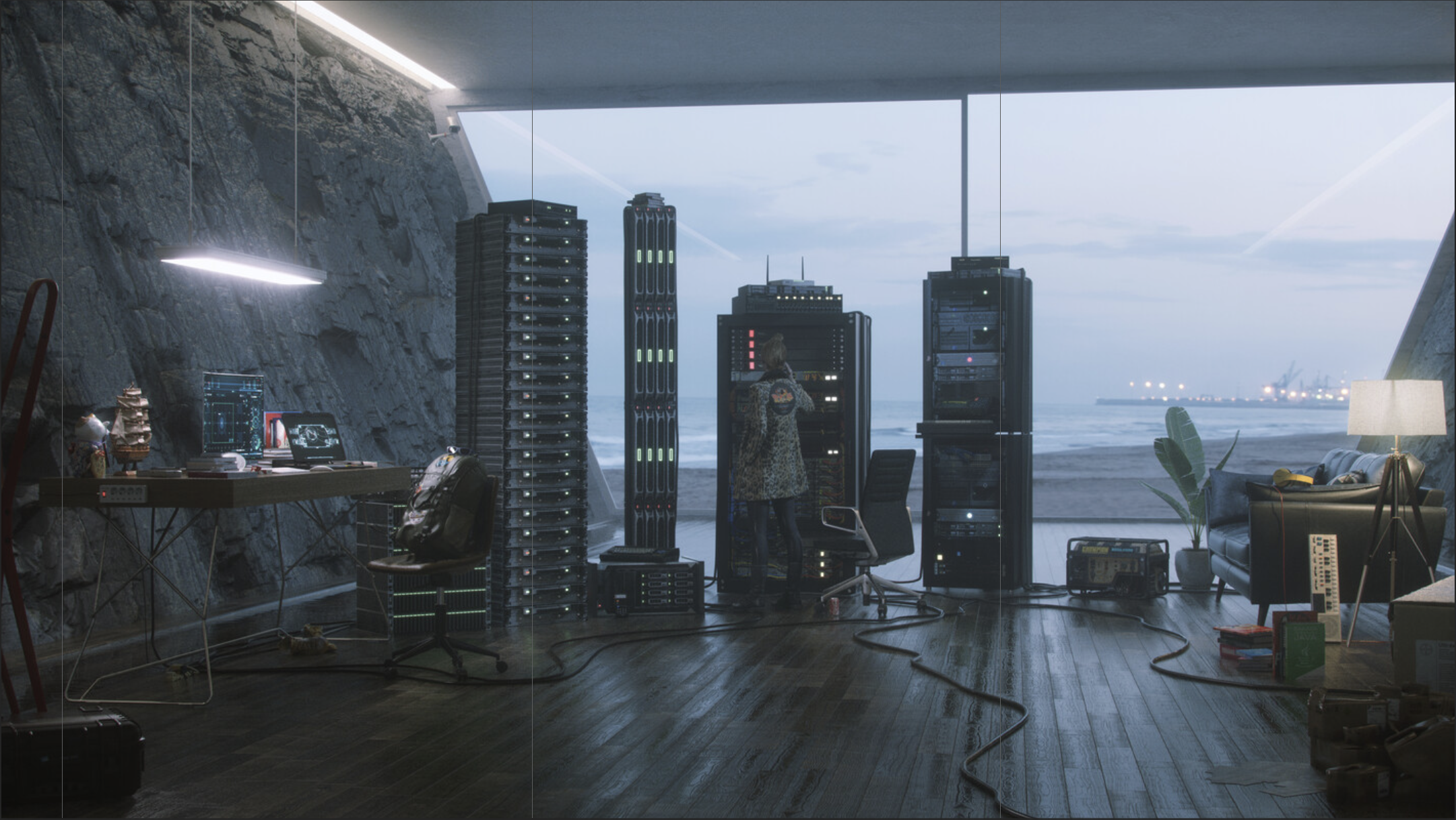
A large language model lives in a rack.
Rows of accelerators. Vast pools of high-bandwidth memory. Fans turning hard enough to make the room feel mechanical. The larger the model, the larger the rack. The larger the rack, the stronger the argument for another data center, another power contract, another billion-dollar construction plan.
That sequence has become so familiar that it no longer sounds like an engineering decision. It sounds like physics.
But it is not physics. It is an architecture.
What if a machine Apple released in 2019 could run a 744-billion-parameter language model—not by somehow squeezing the entire model into memory, but by learning to move the right pieces of it at the right time?
The machine in question is not exotic. It is a twelve-core Intel Xeon W Mac Pro with 256 gigabytes of ordinary DDR4 memory and a RAID made from four consumer NVMe modules. Its graphics card, an aging Radeon Pro 580X, is almost beside the point. The model is GLM-5.2: a sparse Mixture-of-Experts system containing 19,456 routed experts and occupying roughly 372 gigabytes at four-bit precision.
The model is larger than the machine's memory. That is the point.
It cannot simply be loaded and left there. Most of it must remain on storage. The experiment asks whether disciplined prediction, placement, prefetching, and scheduling can make the missing pieces arrive before the computation needs them.
This is not a promise that an old Mac Pro will outperform a modern accelerator cluster. It will not. Nor is it a claim that the model will immediately feel as responsive as a commercial cloud service.
It is a more consequential proposition: the rack may not be the only place where advanced machine intelligence can live.
The open-source colibrì runtime has already established the underlying existence proof. It streams a full sparse model from disk and can operate at a very low memory floor while preserving the model's routing and precision policies on its default path. Its published validation includes token-exact checks against a reference implementation. At the smallest memory budgets it is slow, as one would expect. But existence proofs do not have to defeat the incumbent to alter what the incumbent must explain.
The Mac Pro experiment asks the next question: can a machine with substantially more memory, a striped NVMe array, and carefully controlled software turn mere feasibility into useful responsiveness?
That question feels new. The pattern behind it is not.
Before personal computers became ordinary, much of computing happened somewhere else. The machine belonged to a university, a corporation, or a government agency. A terminal on your desk gave you access to an institution's capital expenditure. You were granted an account. You submitted work. You waited for time. Every experiment passed through somebody else's scheduler, budget, security policy, and judgment about what counted as a reasonable use of the machine.
The personal computer did not overturn that system because it was immediately more powerful. It was not. A desktop machine could not compete with a mainframe on the mainframe's own terms.
The decisive change was location.
The application ran where the person was. The work moved to the user instead of the user queuing for the work. Once that became possible, even imperfectly, the structure of the industry changed around the possibility. New software markets appeared. New companies became viable. New people gained the ability to experiment without first persuading an institution to allocate them time.
The personal computer did not make centralized computing disappear. It ended centralized computing's monopoly on the imagination.
Artificial intelligence is beginning to face a similar choice.
Today, the dominant assumption is that meaningful intelligence lives in someone else's building. You access it through an account. The provider decides which model is available, what it costs, how long it remains available, which policies govern its use, how the interface behaves, and whether yesterday's system will still exist tomorrow.
That arrangement may remain economically sensible for many applications. Centralized systems offer enormous performance, operational convenience, shared infrastructure, and continuous upgrades.
But convenience is not the same thing as inevitability.
A local model changes the relationship between the person and the capability. It can be inspected, instrumented, modified, preserved, run offline, and integrated into private workflows. It is not merely a service being consumed. It is machinery under the operator's control.
The Mac Pro experiment should therefore be read in the register of the early personal computer. It is not trying to prove that a workstation can out-compute a data center. It is testing whether intelligence can be reorganized so that a machine already in hand can possess and operate a model that was assumed to require a rack.
The reason this is possible begins with a distinction between two kinds of models.
A dense neural network is like a company that requires every employee to participate in every decision. Each time the model produces a token, nearly all of its major weight matrices are used. If those weights do not fit in fast memory, the system faces a fundamental problem. It would have to move an enormous portion of the model for every generated word.
A Mixture-of-Experts model is organized differently.
It contains a shared central system—the attention layers, embeddings, normalization, routing logic, and other components used repeatedly. Around that common trunk sits a large population of specialist networks called experts.
For each token and each expert layer, a router chooses only a few specialists to consult.
Imagine a company with thousands of highly specialized employees. One understands tax law. Another is unusually good at SQL. Another handles poetry, chemical notation, Mandarin syntax, contract language, or mathematical proofs. The company does not invite all nineteen thousand specialists into every meeting. It calls the handful needed for the problem immediately in front of it.
The total organization may be enormous while the active workforce at any instant remains comparatively small.
That asymmetry creates a deployment option that dense models do not offer.
The shared trunk is used constantly, so it belongs in fast memory. But any individual expert may be selected only occasionally. Its weights can remain on a slower tier until the router calls for them.
In the Mac Pro experiment, RAM is the office next to the conference room. The NVMe RAID is the warehouse. The experts are instruction manuals stored across the two locations.
The system does not need every manual on the desk. It needs the right manuals to arrive before the meeting reaches the agenda item that depends on them.
This changes the nature of the problem.
The machine may not be slow because it lacks enough arithmetic. It may be slow because the next manual has not arrived.
Storage-tier Mixture-of-Experts inference is therefore not primarily a compute problem. It is a logistics problem.
The central questions become familiar ones. Can we predict the next request? Can we place frequently valuable material closer to the work? Can related items be stored together? Can one delivery serve several tasks? Can we stop a rare traffic jam from freezing the entire operation?
Once the problem is stated that way, the research program becomes easier to understand. It is not an attempt to invent an entirely new model. It is an attempt to operate an existing sparse model more intelligently.
Systems engineers naturally measure bandwidth, cache hit rate, prediction recall, and tokens per second. All four are useful. None, by itself, tells us what the user is actually waiting for.
A storage device can report excellent bandwidth while still serving the wrong data too late. A cache can achieve a high hit rate by retaining many cheap, low-consequence items while missing the one expert whose storage read dominates the next layer. A predictor can become more accurate while producing no visible speedup. A system can increase average throughput while introducing pauses that make an interactive session feel worse.
One of the most revealing results behind this research program was not a success. It was a failure.
A cross-layer coupling predictor was added to colibrì. It learned that the experts selected at one layer constrain which experts are likely to appear at later layers. Measured as a prediction system, it worked: held-out prediction recall improved.
Measured end to end on a warm-cache machine, it did not help. A modest configuration was neutral; a more aggressive one was slower.
The prediction was better, yet the user would have experienced no benefit.
Why?
Because the machine's operating-system cache had already hidden much of the storage delay. The predictor became better at forecasting events that no longer caused meaningful waiting. At a larger prefetch budget it also generated enough speculative traffic to create congestion. It optimized prediction accuracy, not the delay that remained visible.
That result exposes a general problem: prediction accuracy is not the same thing as avoided waiting.
A prediction can be correct but useless because the data was already resident. It can be correct but late because the load completed after the layer needed it. It can be correct but harmful because speculative reads crowded out urgent demand reads. It can improve cache statistics while increasing total I/O. It can make the average look better while worsening the rare pauses that dominate the feeling of an interactive system.
The proposed replacement metric is expected foreground stall per committed token.
The phrase sounds technical. The idea is simple.
Foreground stall is the time the model is actually blocked waiting for expert data after all useful overlap has been accounted for.
If a read takes twenty milliseconds but runs entirely behind computation that was happening anyway, it contributes no foreground stall. The user never felt it.
If the same read starts too late and forces the next layer to wait fifteen milliseconds, those fifteen milliseconds count.
The denominator matters too. Modern models can use speculative decoding, in which the system drafts several possible future tokens and then verifies them together. Drafted tokens that are rejected still consume work. A system should not receive performance credit for evaluating ten speculative positions if only two become actual output.
That is why the metric is normalized by committed tokens: the tokens the model really accepts and emits.
In ordinary language, the research asks: for every token the model actually produces, how much time was it forced to sit idle because required expert data had not arrived?
That one question brings several formerly separate techniques onto the same scoreboard. It also reveals why their gains may compound—and why they may interfere.
Foreground stall can be reduced through four broad levers: prediction, placement, amortization, and tail control.
First, predict what will be needed—but respect a budget. The runtime already has several clues about future expert use. One clue comes from router lookahead: the current layer's hidden state can be passed through a later router to estimate which experts that later layer will select. Another comes from cross-layer and cross-token correlation: particular experts tend to be followed by particular experts, and recent tokens often resemble the next token. A third comes from trajectories. Two prompts that begin to activate experts in similar patterns may continue along similar routes. A fourth comes from the current session. If a conversation has spent twenty minutes discussing tax law, some specialists are more likely to remain useful. A fifth comes from long-term personal history. A developer who repeatedly asks about Python, distributed systems, and databases creates a different routing profile from a lawyer, a chemist, or a fiction writer.
Much of this signal has already been explored in published systems. The proposed advance is not to pretend that one more predictor solves the problem. It is to translate every prediction into the same operational question: how much residual waiting is this possible load likely to prevent, given its deadline, byte size, current tier, and effect on the queue?
Confidence matters because prefetching is not free. Every speculative load consumes bandwidth, queue capacity, memory space, and perhaps cache residency that a real request might soon need. An aggressive predictor can become a traffic generator, filling the road with trucks carrying manuals nobody will open. So prediction breadth must be budgeted. When the signals agree strongly and the expected stall avoided is high, the system can fetch confidently. When they disagree, or when the storage queue is crowded, it should remain narrow. Demand reads must always outrank guesses. The predictor is valuable only when the waiting time it removes exceeds the congestion and cache pollution it creates.
Second, arrange the warehouse according to waiting time saved. Traditional caches tend to ask a simple question: which item is used most often? A stall-aware cache asks a different question: which resident byte prevents the most user-visible waiting?
Those rankings are not always the same. Suppose one expert is requested frequently but is already likely to be found in the operating system's page cache. Keeping another copy pinned in application memory may save little. A second expert may be requested less often, but every miss requires a costly cold read from the RAID. Pinning that expert could prevent far more waiting. The correct unit of value is therefore not popularity. It is expected stall avoided per byte of scarce fast memory.
The same logic applies inside each expert. Today, an expert may be treated as one indivisible object. Prior work has shown that an expert can instead be split into segments, keeping the most useful portion in fast memory and leaving the remainder on a slower tier. Instead of storing a small number of complete manuals beside the desk, the system keeps the most frequently useful chapters from a much larger number of manuals. When an expert is selected, computation can begin on the resident segment while the remaining segment is being read. The system reduces cold bytes and creates more time in which to hide their arrival.
Physical arrangement matters too. Warehouses do not store items randomly when they are frequently ordered together. Supermarkets place related products nearby. Fulfillment centers learn which combinations belong in the same picking path. Expert storage can use the same principle. If particular experts often activate together, their weights can be placed next to one another on disk. A correlated burst of requests may then become one larger sequential read rather than several scattered reads.
Third, make one delivery serve more than one token. Speculative decoding is usually explained as a compute optimization. A model proposes several possible future tokens, verifies them in one operation, accepts the valid prefix, and discards the rest. When acceptance is high, several tokens can be produced from one expensive forward pass.
For storage-tier inference, speculation offers a second benefit. Several drafted positions may need overlapping sets of experts. If three future positions all require the same specialist, that expert needs to be loaded only once for the verification batch. One warehouse delivery serves several pieces of useful work.
But the economics must be measured honestly. Drafting more positions increases the number of potential experts the system might need. Rejected drafts still caused loads. Speculation helps only when accepted output grows faster than the union of expert data required to evaluate it. That is why the relevant quantity is not merely drafts per step. It is expert-union bytes per committed token. A system that drafts four positions, touches four largely disjoint expert sets, and accepts one token may make storage performance worse. A system that drafts four, reuses many of the same experts, and accepts three may dramatically amortize each load. The model must earn the right to speculate.
Fourth, stop rare traffic jams from defining the experience. Interactive systems are not judged solely by averages. A system that responds steadily at one token per second may feel more usable than one that averages two tokens per second but freezes unpredictably for several seconds.
Expert misses are correlated. A layer may suddenly need several cold experts at once. Prefetch traffic, demand traffic, and operating-system reads may converge on the same queue. One unlucky burst can dominate the user's perception of the entire interaction.
The first defense is ordinary operational discipline: bounded worker pools, demand-read priority, strict speculative-byte budgets, cancellation of stale prefetches, queue monitoring, and explicit reporting of p95 and p99 latency rather than averages alone. The lossless default path must remain sacred. The router chooses the same experts. The weights remain at the same precision. Whether an expert came from RAM or storage changes only how long the model waited, not what computation it performed. Token-exact comparison against a reference implementation enforces that boundary.
The Mac Pro is valuable for this experiment not because it represents the fastest available hardware, but because its limitations are unusually informative.
The model occupies roughly 372 gigabytes. The machine has 256 gigabytes of RAM.
That gap guarantees that storage matters.
At the same time, 256 gigabytes is enough to vary how much of the expert population remains resident. The experiment can impose fixed memory budgets and observe the system as it moves through distinct operating regimes. At 64 gigabytes, the machine should be strongly storage-bound. At 128 gigabytes, caching and placement begin to matter more. At 192 gigabytes, a large portion of the useful expert population may remain warm, and the bottleneck may begin shifting toward memory bandwidth or computation.
The four-drive NVMe RAID adds another useful variable. It may be fast enough that some optimizations become irrelevant. That would not invalidate the theory. It would identify the boundary at which the bottleneck moves.
The machine can therefore reveal an entire curve: cold-tier dominated, cache-sensitive, high-residency, and potentially compute-bound. This is more scientifically useful than testing only the fastest configuration and announcing one tokens-per-second number. The Mac Pro is not merely the target. It is the measuring device.
It would be easy to turn this experiment into a dramatic benchmark hunt. Enable every optimization. Choose the friendliest prompt. Warm every cache. Report the best run. Compare it with a poorly configured baseline. Declare victory.
That is not the proposed program.
The first code change is instrumentation, not optimization. The runtime must record when each expert load was requested, when it completed, when the layer actually needed it, which storage tier served it, how many bytes moved, how crowded the queue was, how many speculative positions were evaluated, how many tokens were accepted, and how much foreground waiting remained.
Only after that trace is trustworthy should new mechanisms be added. The unchanged colibrì runtime becomes the control. Existing capabilities are measured one at a time under fixed memory budgets. Then each additional idea receives its own branch and its own falsifier.
If trajectory retrieval does not beat simple lookahead, the result is recorded. If a more accurate predictor increases queue contention, the result is recorded. If the RAID makes co-activation layout irrelevant, the result is recorded. If multi-token drafting expands expert unions faster than it produces accepted output, the result is recorded. If the CPU becomes the bottleneck before storage optimization has room to pay, the result is recorded.
This matters because the research is not claiming that every individual technique is new. The contribution is the common discipline that forces them to answer the same question under the same constraints: how much foreground waiting disappeared per committed token?
All of the mechanisms share resources. A broader prefetcher may consume the same queue capacity needed by speculative loading. A larger hot store may reduce the memory available for buffers. Splitting experts may increase bookkeeping. Better prediction may become irrelevant once the page cache is warm.
The only defensible composition is the measured one. That posture is not caution for its own sake. It is what turns an interesting demonstration into credible engineering.
Suppose the experiment succeeds.
A model far larger than local memory becomes meaningfully responsive on hardware someone already owns. The achievement comes not from inventing a new accelerator, changing the model's answers, or constructing another data center. It comes from understanding the timing and movement of data.
That result would not mean every company should abandon the cloud. It would mean the deployment frontier is wider than the cloud industry's preferred architecture suggests.
Large sparse models might operate in laboratories that cannot justify accelerator clusters. They might run inside organizations with strict privacy requirements. They might remain available even when a vendor changes pricing, policy, model versions, or access terms. They might become durable components of local systems rather than temporary capabilities rented through an interface. Researchers could inspect the actual routing and storage behavior rather than infer it from an API. Developers could build around a model that does not disappear when an account is closed. Individuals could maintain intelligent tools whose memory, configuration, and operation remain under their control.
The important word is not local. It is optional.
Centralized infrastructure remains powerful. The question is whether it remains mandatory.
And if the experiment fails? Then it should fail specifically.
Perhaps this checkpoint's routing is not predictable enough. Perhaps nineteen-megabyte experts are too coarse for layout to matter. Perhaps the RAID already outruns the CPU. Perhaps the page cache obscures the storage tier. Perhaps speculative I/O causes more pollution than useful overlap. Perhaps the machine's memory bandwidth becomes the binding constraint long before the model feels conversational.
Each failure narrows the next decision. That is the difference between an experiment and a demonstration. A demonstration is designed to produce a desired impression. An experiment is designed to distinguish among explanations. Either outcome moves the argument forward.
The personal computer did not replace the mainframe by becoming a smaller mainframe. It changed the unit around which computing was organized.
The mainframe organized computation around the institution. The personal computer organized it around the person.
The rack organizes artificial intelligence around centralized capital. The storage-tier model asks whether some forms of intelligence can instead be organized around movement: keep the common machinery close, predict which specialists will be needed, retrieve them before they are called, and measure only the waiting that remains visible.
This is not a claim that logistics can repeal physics. Storage is slower than memory. Consumer hardware has finite bandwidth. Large models require energy, cooling, and patience. A 2019 workstation will not become a six-GPU server because its files are arranged cleverly.
But architecture determines which physical limits matter.
A dense model demands residency. A sparse model creates choices.
Once choices exist, software matters. Prediction matters. Layout matters. Scheduling matters. Personal history may matter. The shape of the workload matters. The difference between a read that takes twenty milliseconds and a read that causes twenty milliseconds of waiting matters.
The rack is not obsolete. It is not unnecessary. It is not going away.
But it may not be inevitable.
The personal computer changed computing by demonstrating that useful work could happen where the person was—and by allowing the rest of the industry to draw conclusions from that fact.
A 2019 Mac Pro running a 744-billion-parameter sparse model would not settle the future of artificial intelligence. It would do something more useful. It would reopen the question of where that future is allowed to live.
The underlying shift is not merely technological. It is architectural.
Just as Onli’s architecture shifts digital ownership from centralized ledgers to actual possession, storage-tier inference shifts the execution of intelligence from centralized racks to the edge. When computation is no longer bound to the data center, the nature of control changes. The model becomes a local asset. The intelligence becomes a capability you possess, not a service you rent.
When you possess the capability, you dictate the rules. The system becomes an extension of the owner. And in a world where intelligence is allowed to live anywhere, the architecture that guarantees possession—of data, of models, of outcomes—becomes the foundation of the next economy.
About The Onli Corporation
The Onli Corporation develops infrastructure for creating, financing, delivering, and governing entirely new classes of digital assets. Through actual possession, private digital markets, and programmable digital property, Onli enables organizations to build secure, scalable digital economies beyond the limitations of traditional blockchain architectures.
To learn more, contact hello@theonlicorporation.com.
Download OnliYou on the Apple App Store.
Develop on the Onli platform at https://onli.cloud.